Imagination is a common human ability. However, as we grow up, it doesn’t come naturally to everyone. Many people, who do value imagination, experience strong mental blocks with their minds going blank when they engage in imaginative activities. As a result, they think that they don’t have imagination.
If you are one of them, this post is for you.
Most of us, when we are tasked to imagine something, from generating a new idea to envisioning the future, we first think about the big picture — like a general concept or broad feelings, rather than on vivid visualizations or detailed narratives.
Harnessing our imagination requires more than just daydreaming or broad ideas. It demands a structured approach and consistent practice, for a prolong period of time.
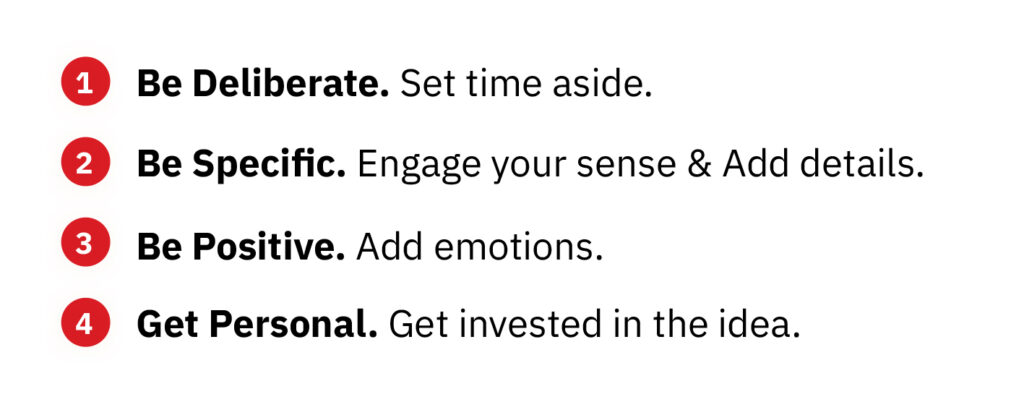
Follow these four steps to start reconnecting with your imagination.
(1) Be Deliberate. We are constantly engaging with our imagination in a passive, unintentional way — such as, when we plan what to cook for dinner or when we think about what we did during the weekend. To reconnect with your imagination, it is important to be intentional about imagining something, like a new scenario, idea, or reality, by setting time aside. Research indicates that 20 minutes is the optimal time for an imagination session. If you spend less time, you won’t be able to build a rich and compelling idea, while if you spend more time you would lose motivation.
(2) Be Specific. The magic is on the details. Think about imagining as writing the script for a movie. The more specifics you can imagine, the more believable and real, the movie becomes. Research on the use of imagination as mental training states that to be effective when we imagine a scene, it should be a rich, multidimensional mental experience. Similarly, Prof. Ruha Benjamin stresses that “specificity is essential for world-building.” By multidimensionally imagining an idea, you are thinking of as many aspects as possible.
How can I imagine multiple details of an idea?
One technique you could use is the 5Ws (Who, What, When, Where, Why) and 1H (How much/many), which involves asking questions from different angles to develop multiple aspects of a story. For instance, building on the idea of a movie, imagine who is/are the main characters, what is the genre of the movie, what inhabits the place, what activities are performed, what is the temperature (are there seasons?), what are the colors, what are the shapes, where does the story occur (specific locations), how do you/the characters feel (emotions). You can continue to imagine outfits, daily routines, systems of governance, etc.
Another common technique is called Engaging All Senses. Use this technique to imagine multiple dimensions of your idea through each sense:
- Sight: Imagine every detail you could see of a specific scenario, room, moment.
- Sound: Imagine any sounds associated with that scenario — indoor/outdoor noises, crowd noise, your voice, music, or environmental sounds.
- Smell: Imagine any relevant smells that you might encounter.
- Touch: Imagine physical sensations that you could feel, like the texture of clothes or the sand beneath your feet on the beach.
- Taste: Imagine any tastes you could experience.
(3) Be Positive. Emotions are the compass. Imagining positive and successful futures — regardless of whether they could be real or not, can cultivate positive emotions and significantly boost well-being by increasing hope, confidence, and focus. In contrast, constantly imagining negative facts and scenarios can lead to increase anxiety and feelings of loneliness. Being in a positive state of mind is important when engaging in an imagination session or workshop.
(4) Get Personal. When imagining a positive future, also imagine aspects that are relevant to your needs, interests, or concerns; this could be from a social cause to a geographical location that you like. Imagine how the idea could help you in some aspect of your life or why would it be valuable to you. The more invested you are in the exercise, the more motivated you will be with the final outcome.
Multisensory engagement and multidimensional details make an imagined scenario feel more real because they strengthen neural connections related to positivity and optimism.
You must be logged in to post a comment.