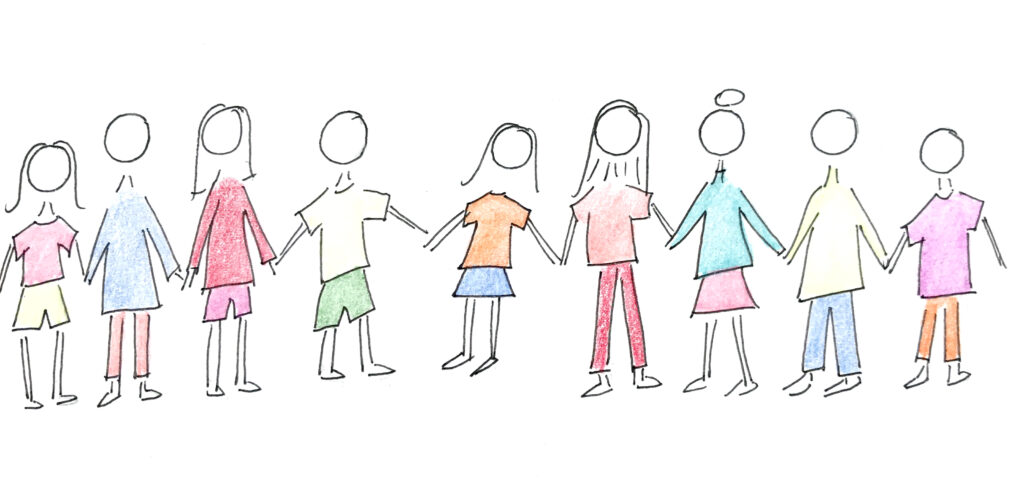
As uncertainty and volatility increase in the world, we must embrace our humanity as a way to individually remain authentic to who we are and collectively support one another. Unfortunately, most efforts are focused on further developing artificial intelligence (AI) and more technology, which has significantly impacted multiple aspects of society, including who we are as humans.
Building on Tyler VanderWeele and Jonathan Teubner’s latest work, the number of sophisticated AI technologies and tools for doing simple and complex things – like writing, communicating, thinking, calculating, analyzing – is rapidly growing and affecting our flourishing. We are forgetting how to be human: how to feel, to think, to listen, to imagine, to understand, to reason, and to act.
Our human skills are underrated and largely ignored.
We have changed how we feel, behave, and interact with one another – and with the more than human world – to the point that we ignore and judge different ways of being and knowing. By not fully embracing our capacity to live and relate we – individually and collectively – have also become more cynical, impatient, and angry as well as feel disconnected, hopeless, lonely, sad, and anxious. Mostly, because we are ignoring our nature.
Our current behaviors – e.g., obsession with social media, inability to slow down, disregard for others, etc. – are a consequence of having forgotten who we are. As Margaret Wheatley states, we can do anything we set our mind to: learn, change, solve, adapt, survive, flourish. And yet, we choose to overvalue AI technologies rather than see them as complementary to our human skills.
The education system also contributes to this picture. It does not equip future generations with the skills they need to be human and survive. Coding, critical thinking, and AI capabilities alone are not enough. Social emotional learning strategies have been integrated in primary and secondary education, but this is rarely the case in higher education. As students move forward in their learning journey, they change the way they see their peers from friends to competitors. What starts as a collective, collaborative journey, ends as a solitary, individualistic, competitive path.
How can we restore our humanity?
How can we become more empathetic, loving, hopeful, and motivated?
Reconnecting with our human skills comes first.
Work on flourishing and human skills is as urgent as work on climate change, existential risk, and better understanding AI technologies. While great attention and financial support are given to the latter, much less interest and funding is devoted to the former. Any future education system and development of pedagogy and learning materials for teaching in the age of AI and preparing the future generations must be framed around human skills and flourishing.
The education focus must shift towards helping students identify their sense of purpose in their lives and learn how to be more loving and caring, as well as how to imagine, listen, and develop deeper and more thoughtful conversations with others. Students need to understand what it is to be human first – this knowledge will then help them leverage AI and remain in control, rather than the other way around.
In the next posts, I will cover some essential human capabilities.
You must be logged in to post a comment.