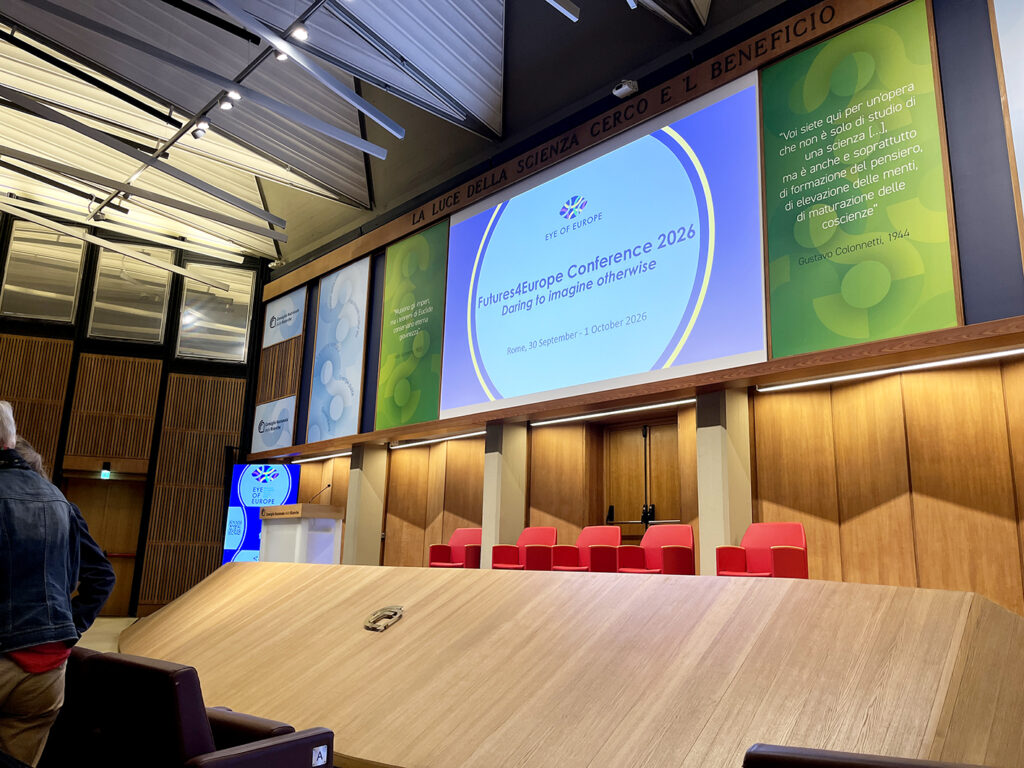
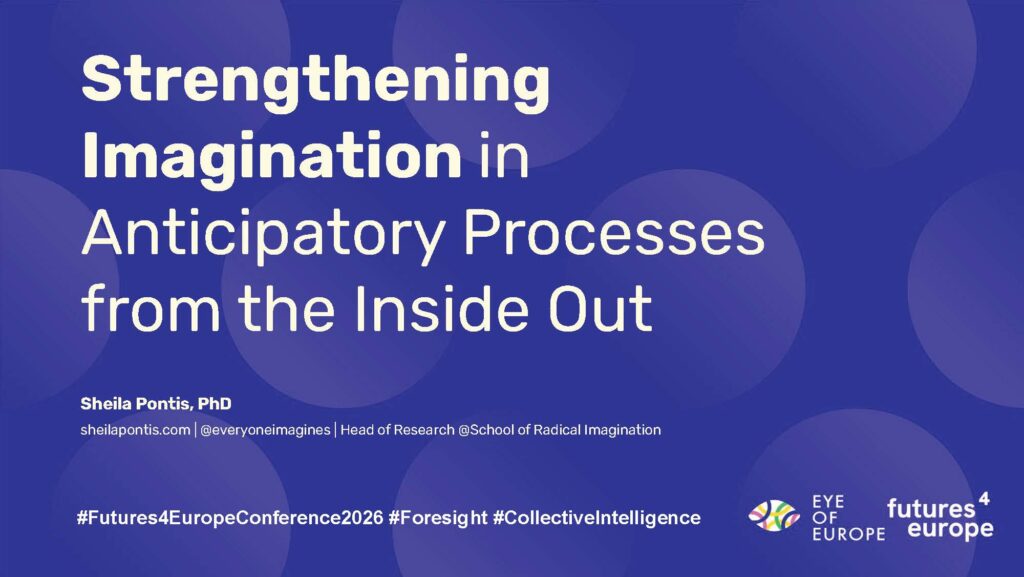
Last week, I presented my interdisciplinary work on imagination at the Futures4Europe Conference 2026 in Rome. “Daring to Imagine Otherwise” was the main topic and the first time Imagination explicitly entered the conversation of the Foresight / Futures community.
Imagination sits at the root of anticipatory processes. However, the tendency is to imagine probable or plausible scenarios that recycle old ideas. Realizing the full transformative power of imagination requires a deep understanding of how it works, and more specifically, what suppresses its full potential: external and internal barriers. My talk focused on these issues by presenting imagination more expansively through an interdisciplinary lens while rooting the crisis on imagination on science to help people make their blind spots visible.
Here are the highlights of the presentation.
Presented on September 30, 2026
Good morning – My name is Sheila Pontis, and my work explores the intersection of imagination, human potential, and the conditions that help people flourish.
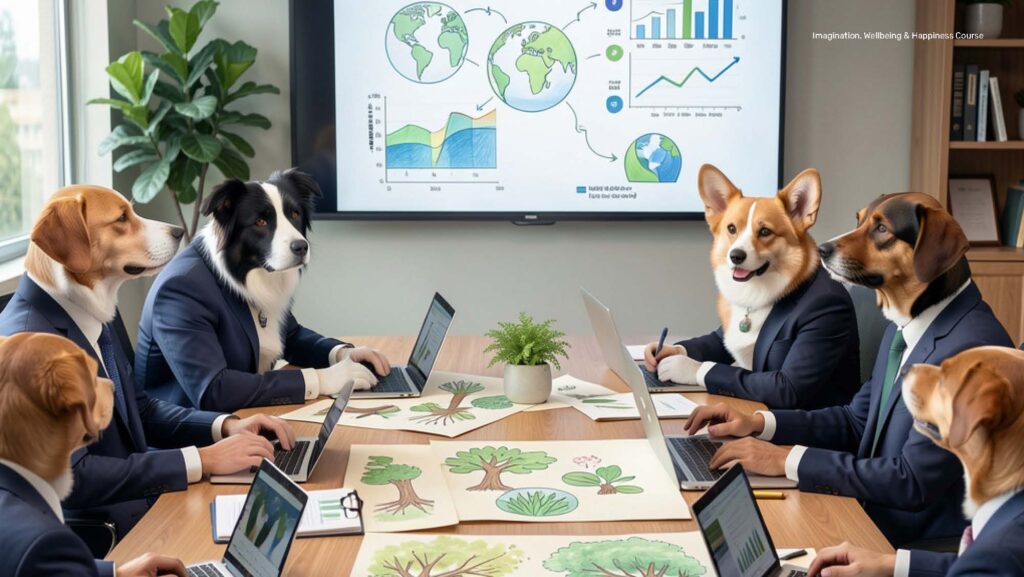
I want to begin with one of my student’s visions about the future in 2040, created for my “Imagination, Wellbeing, & Happiness” in 2025.
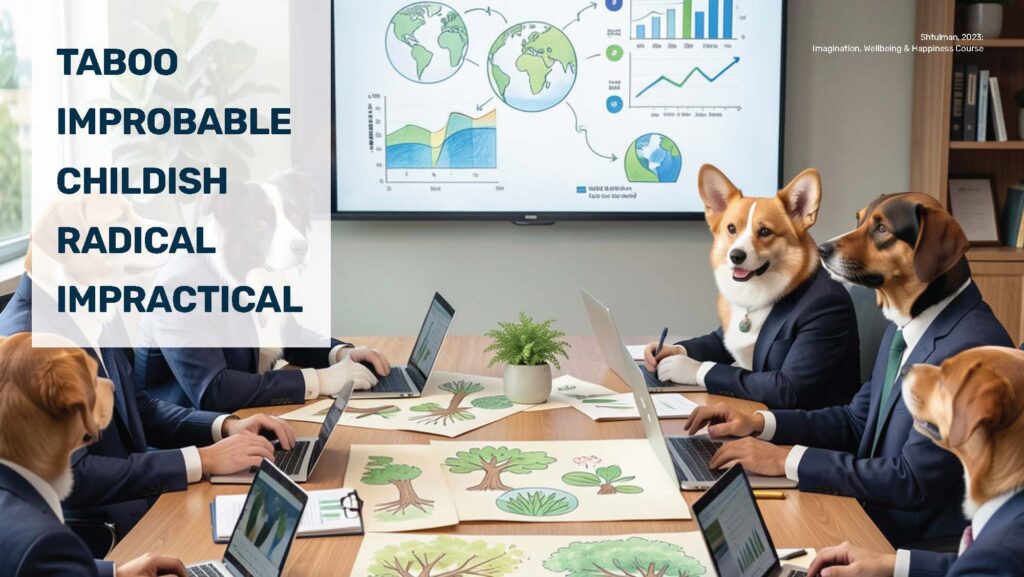
They were proposing a very radically different reality in which pets are the ones governing and we humans live in their world, under their rules. While we could all agree that this seems like a very unlikely or unrealistic future, there may be something to learn from this vision: for instance, what would life be if we completely rethought social conventions?
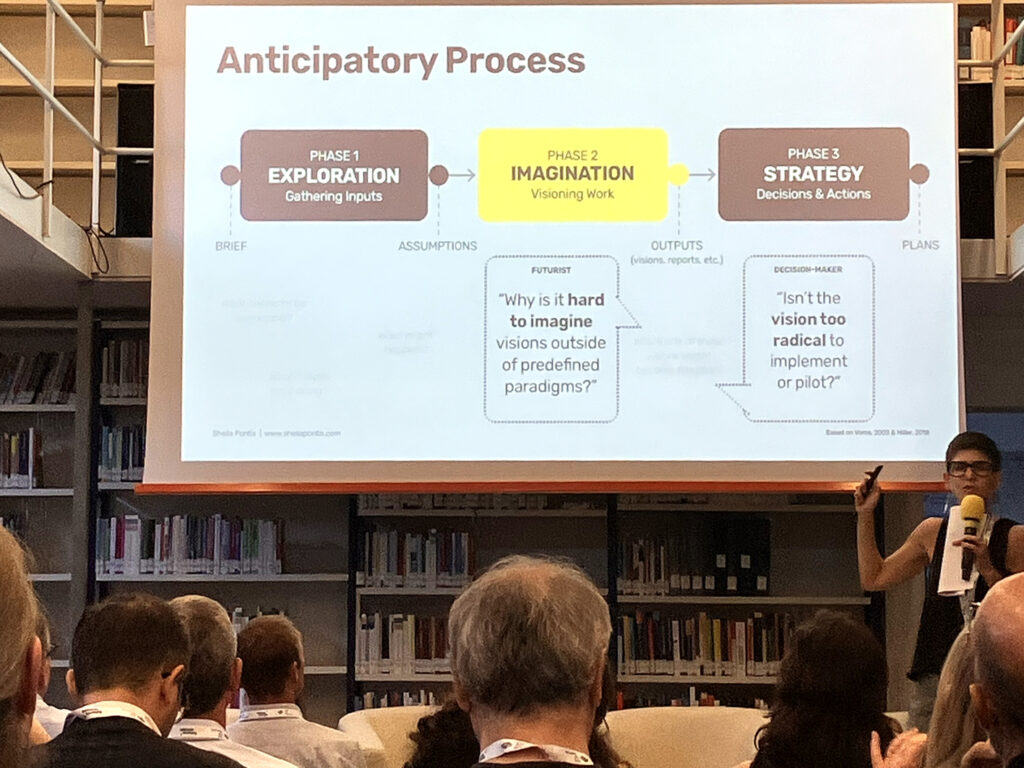
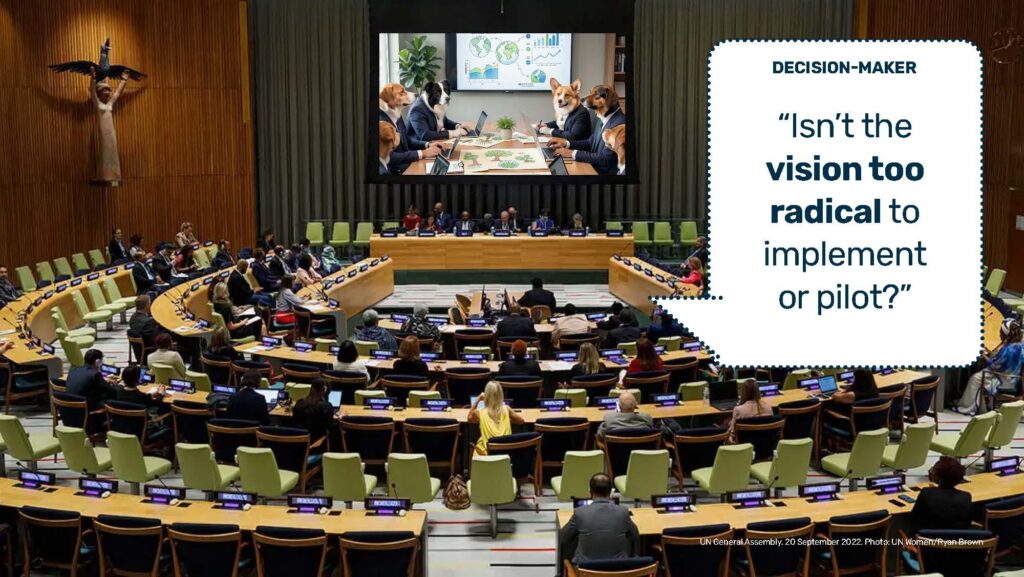
Often, decision-makers, like policy makers or people in UN meetings, question the value and relevance of such radical ideas, and whether it is worth implementing or piloting them.
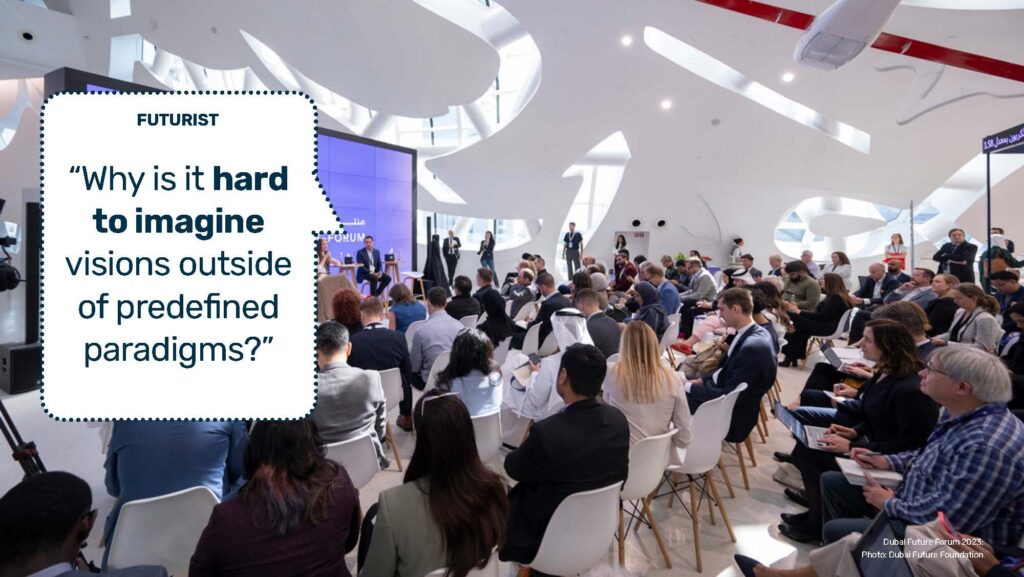
In contrast, futurists or foresight practitioners tend to discuss how we could generate even more radical or transformative visions of the future.
These two questions are often asked during the anticipatory process – and specifically during the middle phase: Imagination, where visioning work takes place and radical visions are generated. Imagination is the core of such visions.
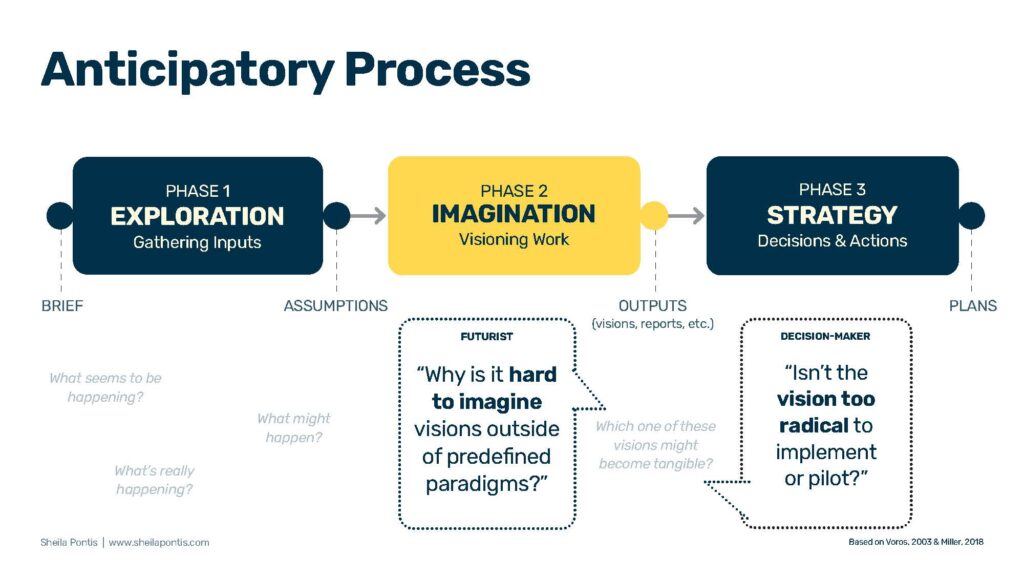
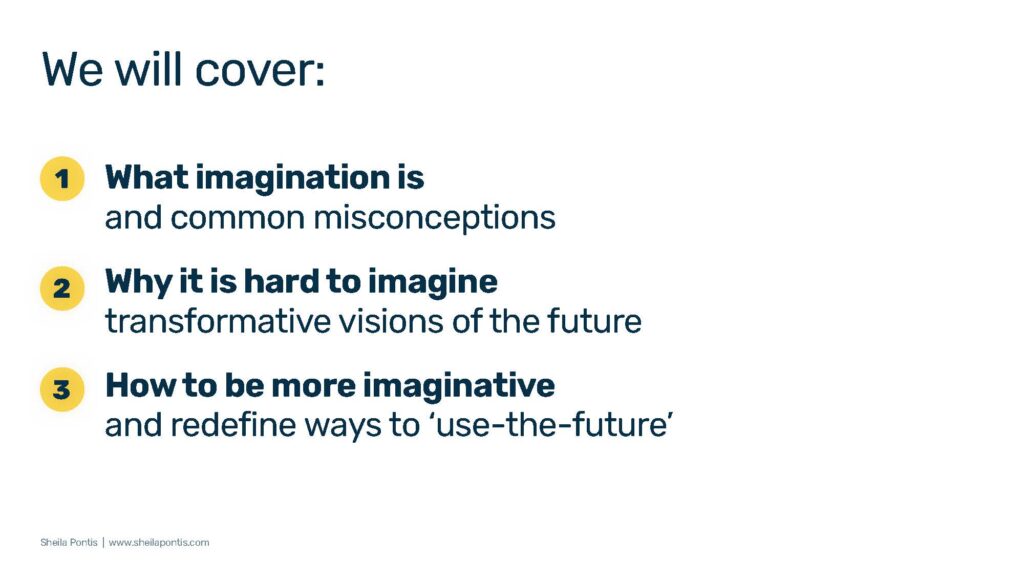
Today I will shed light on three questions: What is imagination? Why is it hard to imagine radical visions?, and what we can do to change that
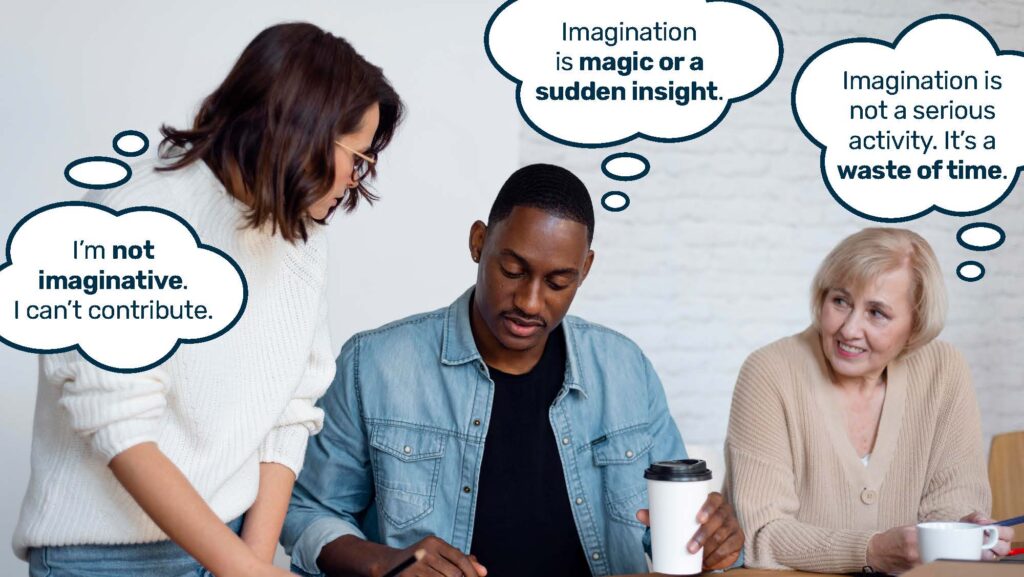
I’m sure that you have at some point been in a meeting and had a similar thought to one of these.
These are three common misconceptions about imagination. So, what is imagination?
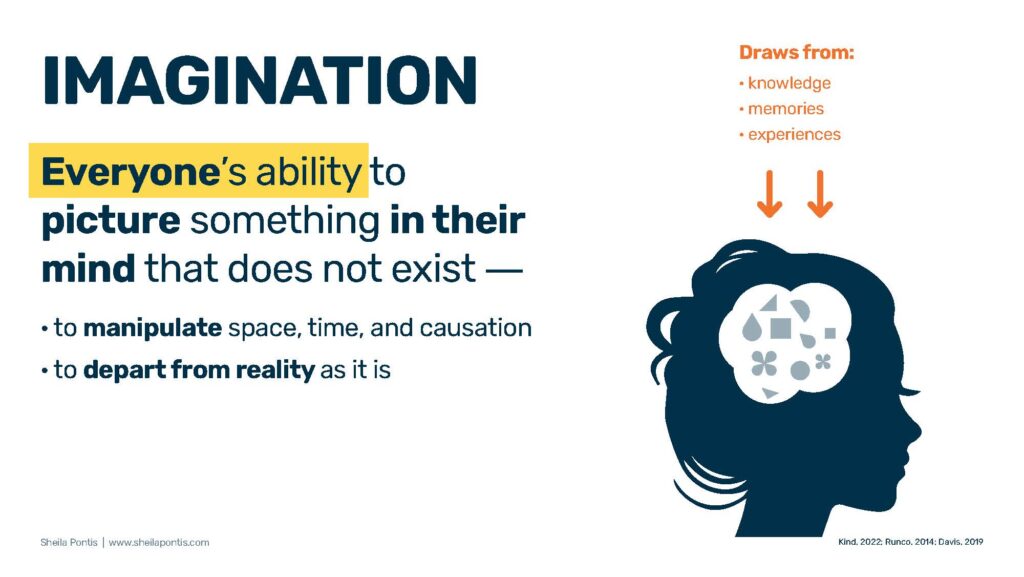
Broadly, imagination is everyone’s cognitive ability to generate something in our mind. It is our ability to time travel, to scape reality, and to play with time, space, and causation by drawing from our memories, knowledge, and experiences gained throughout life.
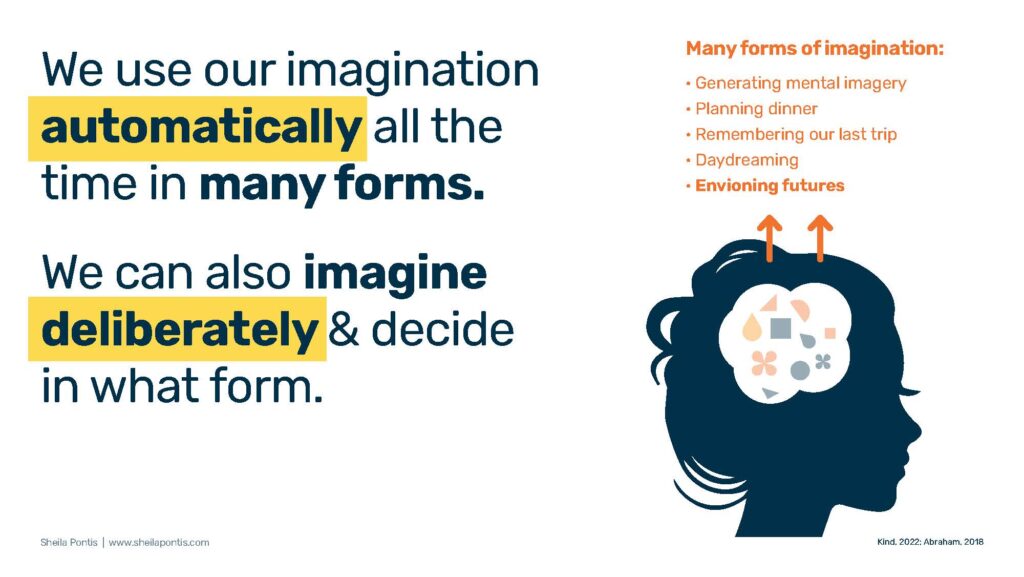
We engage with our imagination 24/7 but we do not notice it, because often imagine in an automatic way, like when we are planning what to eat for dinner or are trying to remember what we did last week. Importantly, we can also imagine intentionally, in a deliberate way, like when we engage in visioning work.
Despite everyone having this ability, there is an imagination deficit, also described as the crisis of individual or social imagination. What do I mean by deficit? That our visions about the future are very similar. We generate the same ideas all the time.
For example, when we think about dystopian futures, there is often robots and humans fighting against each other, like in the Terminator movies, which was initially conceived in 1984, and the cyborg assassin was coming from 2029.
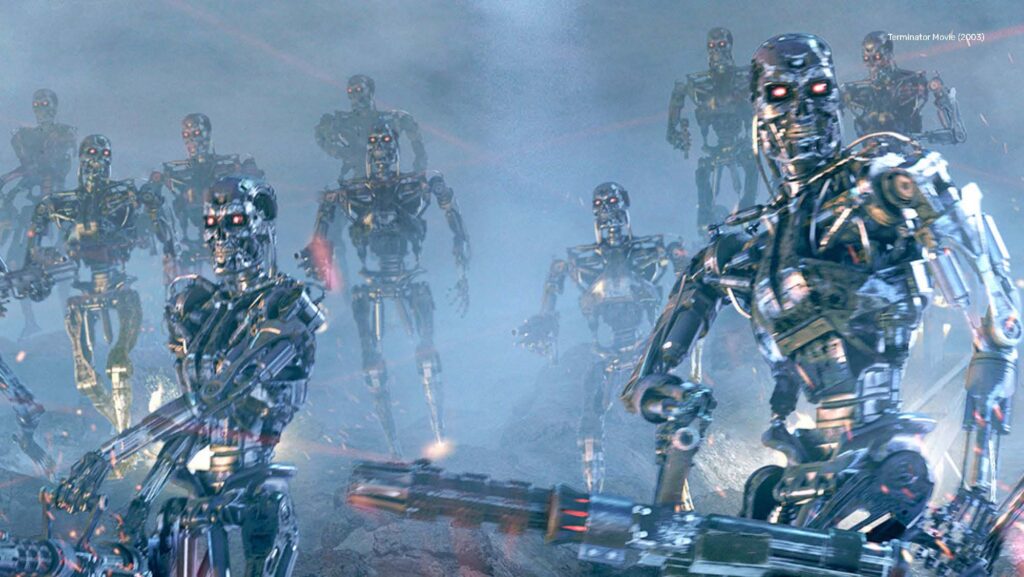
And even much more recently, the Creator Movie (2023) also depicts a future (2070) where nations with AI-machines fight those without this technology.

There are also similarities when we imagine more utopian futures. For example, this is a future vision created by another of my students,
Milena Rogalski in 2025. In her vision for 2040, humans live in harmony with nature and physical infrastructure is integrated with the natural world.

Once again, another vision generated by Jayne Engle from Dark Matter Labs in 2022 also proposes a very similar future.
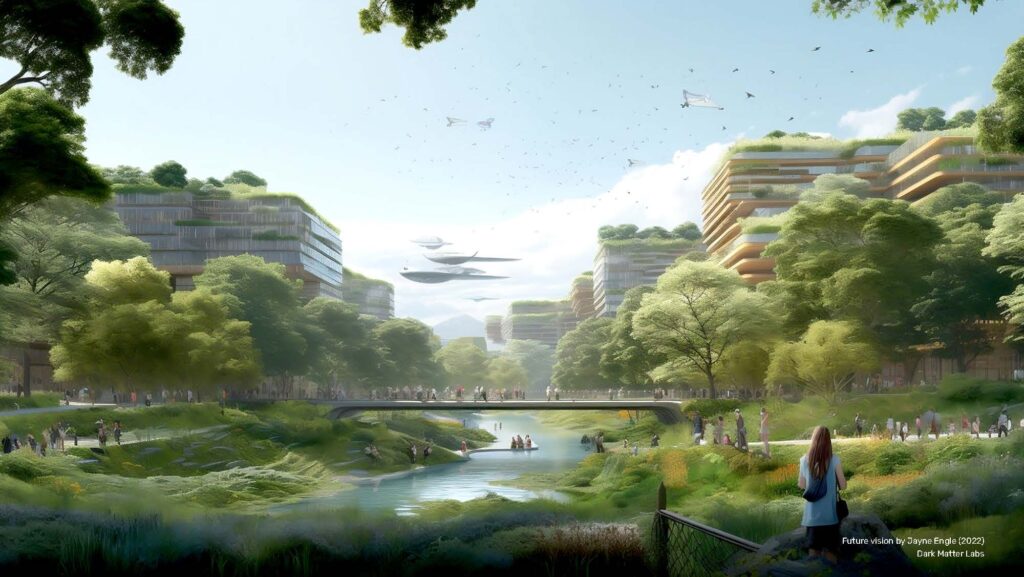
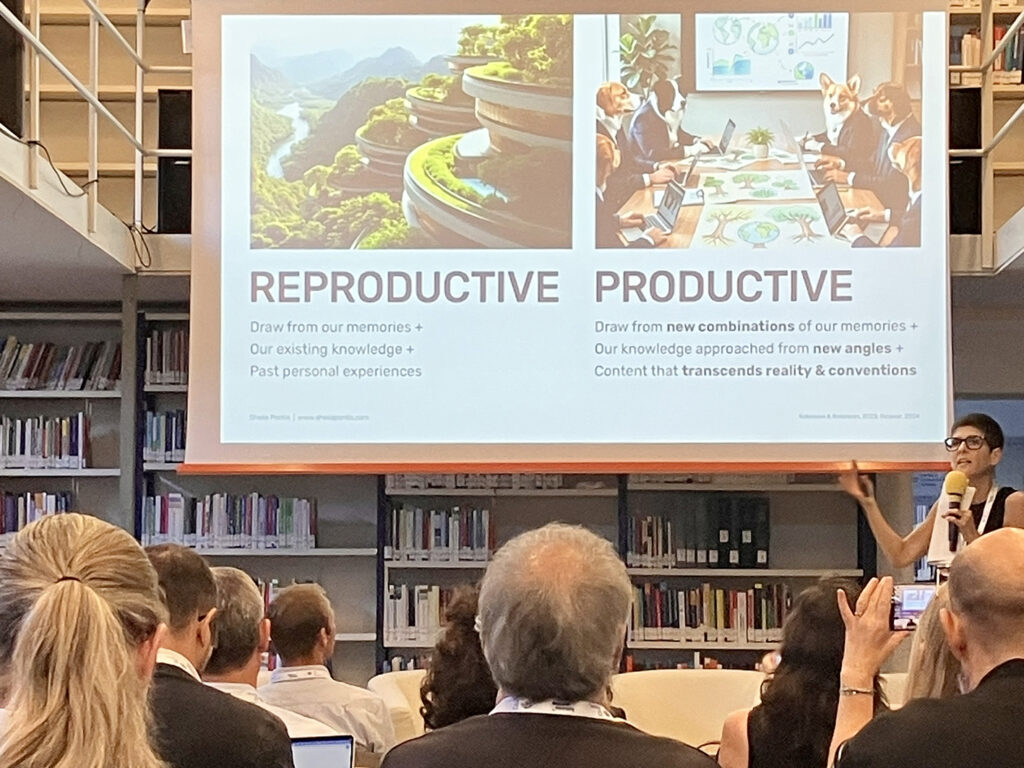
These similarities are the result of people mostly using imagination in a conventional way, which is called reproductive – or optimization or contingency by Riel Miller. When we engage with imagination reproductively, we generate ideas by drawing from memories and experiences that we have seen before. The resulting ideas are safe, expected, conventional, practical, and realistic. There is nothing wrong with this form of imagination.
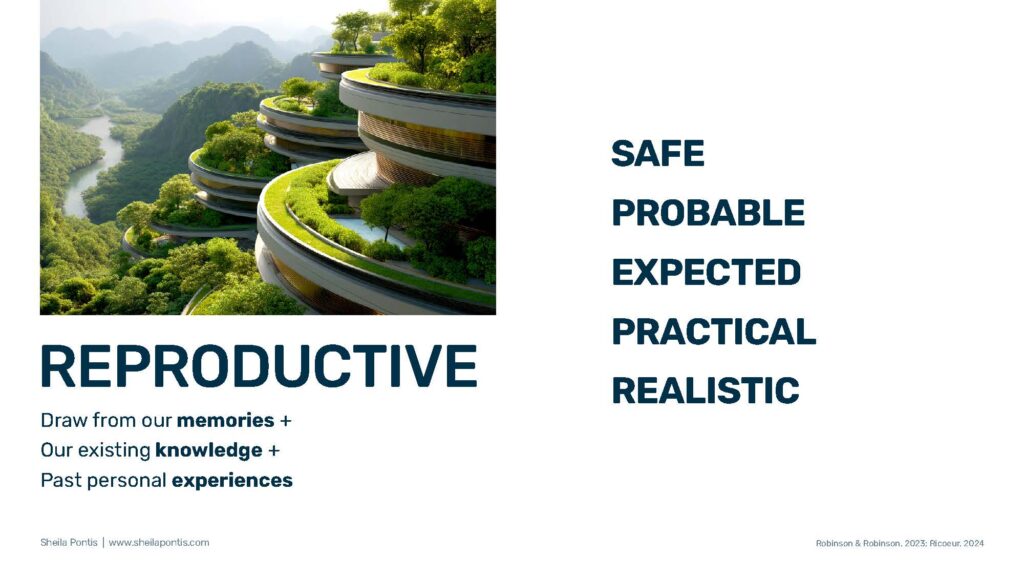
However, transformative visions of the future present realities radically different from what we know or may have seen. To generate this type of ideas, we need to use our imagination in a Productive way, rather than merely reproductively. This means that if we produce visions by recombining our memories in new ways and approaching knowledge from new angles, we could propose ideas that transcend reality and break conventions.
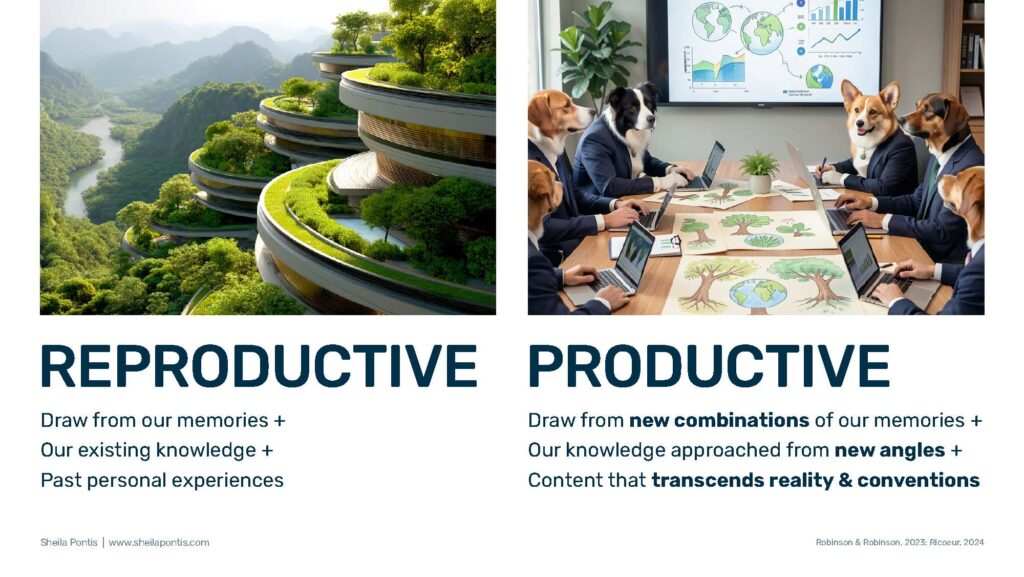
These ideas are often described as unconventional, taboo, childish, and improbable – like the first vision I shared today.
Going back at to the beginning, if everyone can imagine, and productive imagination is what we need to generate transformative vision, why isn’t everyone imagining in this way? There are 2 factors that impact visioning work: Barriers and the inner workings of imagination.
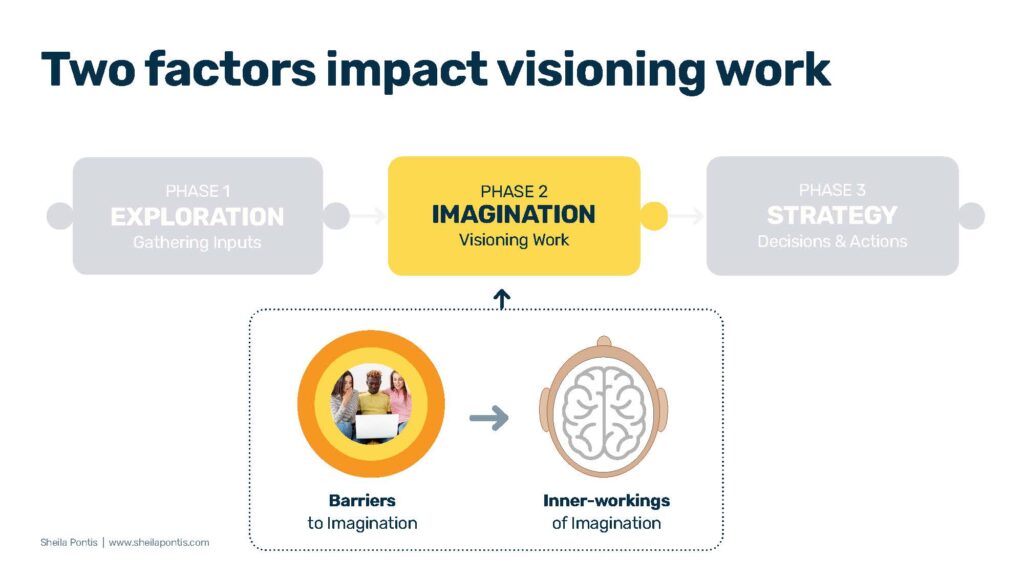
First, external barriers to our imagination hinder our ability to freely generate ideas. While we cannot do anything about these barriers, being aware that they influence us, is important.
External barriers implicitly dictate the types of ideas we generate and make it harder for us to envision something outside the paradigms that they convey – for example, it is very hard to envision a future without robots and machines, or even technology.
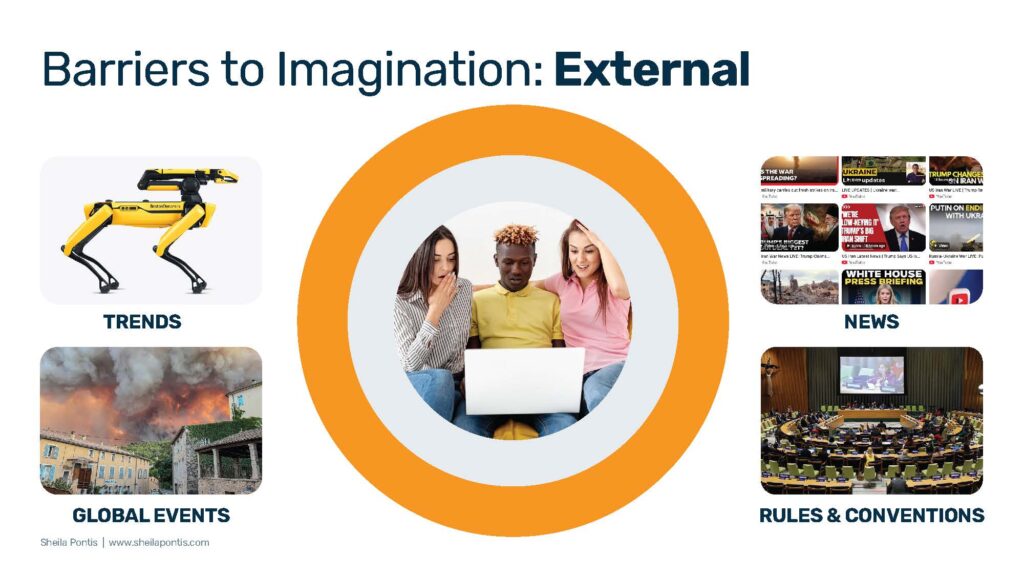
Each of us also has internal barriers that hinder our imagination. We can control these barriers, so identifying which ones are the strongest for us is important to strengthen our imagination.
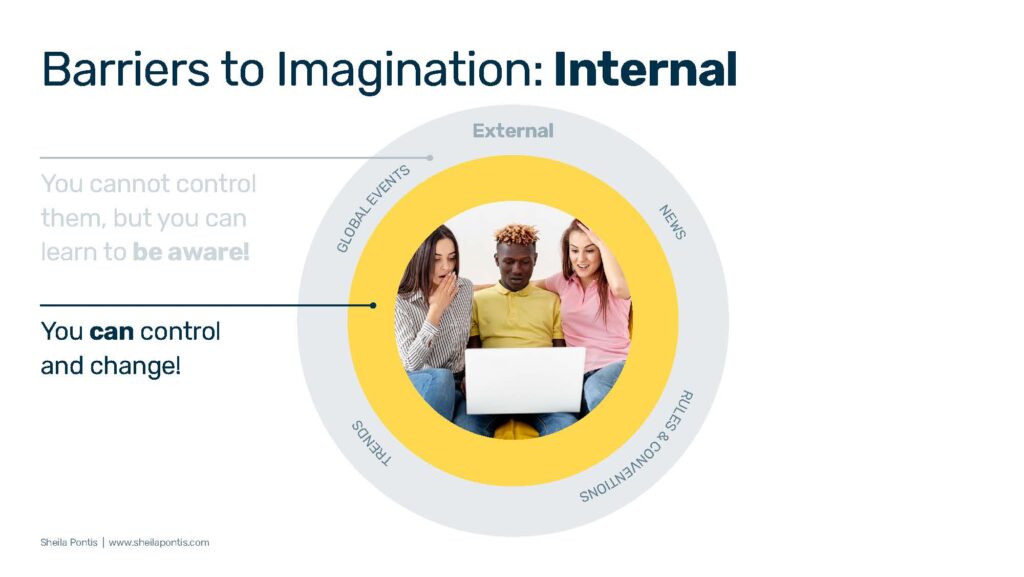
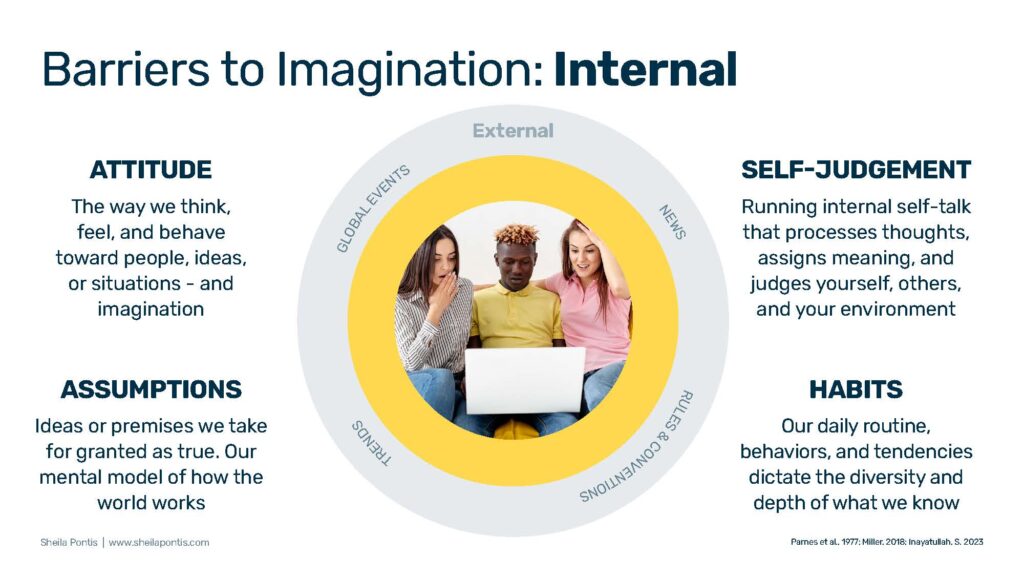
These four are particularly important for visioning work: our attitude and emotions, our inner voice or self-judgement, our assumptions and views of the world, and our habits – the more diverse our experiences, the more new knowledge we can gain.
Second, our lack of awareness about the science of imagination also impacts our work. What does it happen in the brain to make imaginative thinking possible?
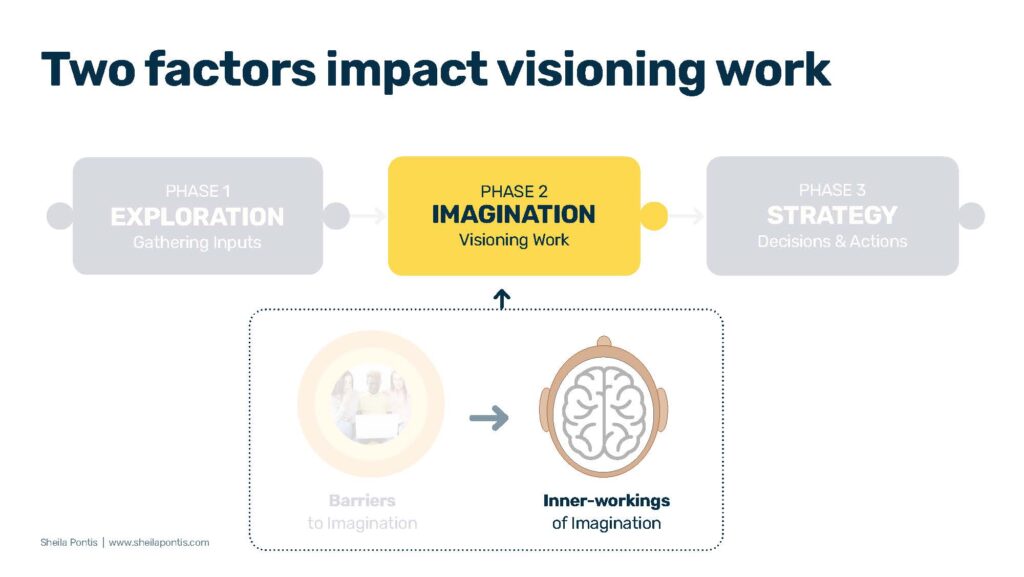
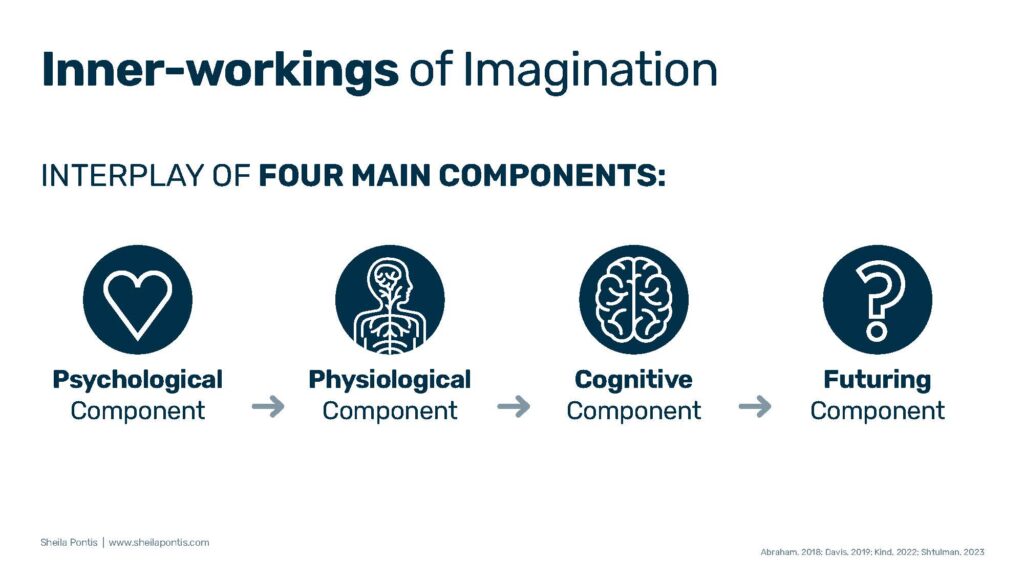
The inner workings of imagination can be boiled down to the interplay of psychological (attitude, emotions), physiological (nervous system, endocrine system), cognitive (brain networks, regions), and futuring (quality, types of ideas, profile) components. Let’s see how these components impact the visioning process.
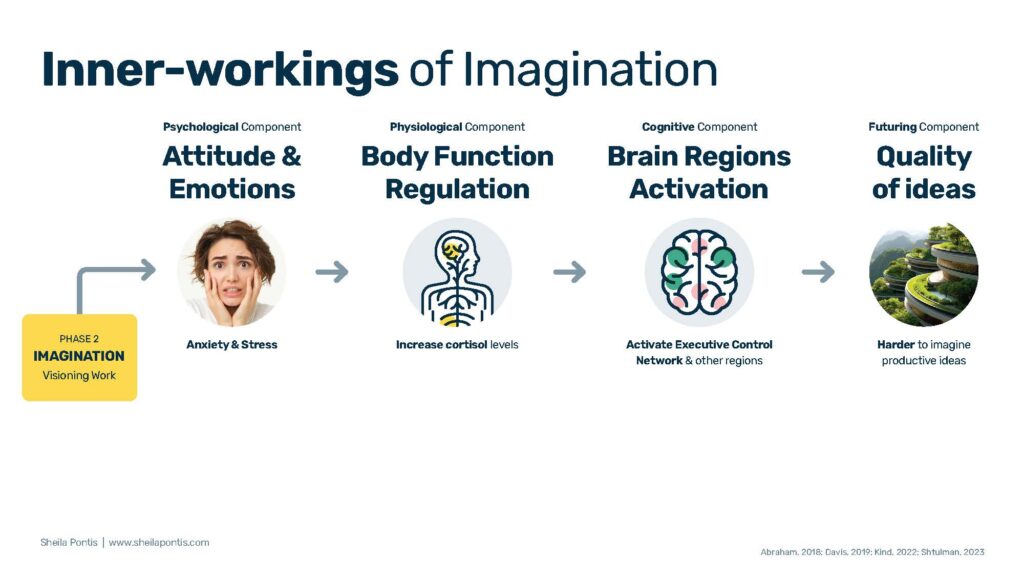
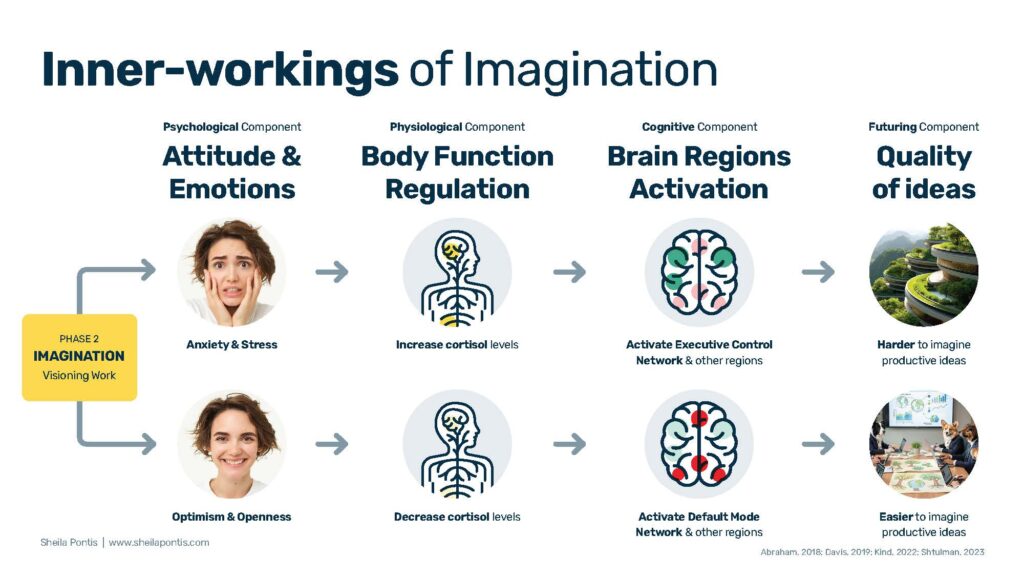
When we start visioning work feeling stressed out, anxious, or with a negative attitude, our levels of cortisol increase, which activates our flight-or-fight response and the executive control network and other regions, like evaluating, judging, and making decisions. These regions and processes do not allow for generating novel combinations of ideas, which makes it harder to generate radical visions.
In contrast, when we start the work with optimism and positive attitude, our cortisol levels decrease, our nervous system is in rest mode which activates the default mode network and other regions, conducive to divergent thinking, associative thinking. This makes it easier to generate productive visions.
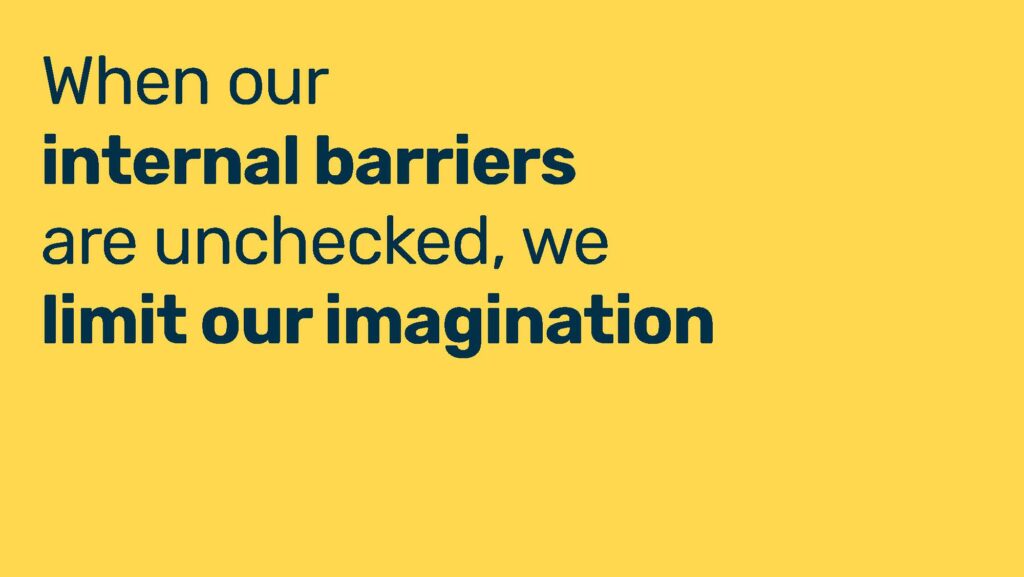
This indicates the strong connection between our emotions and our ability to imagine, as well as the resulting creative quality. Emotions is also one of our barriers. This is why, when our internal barriers are unchecked, we limit our imagination.
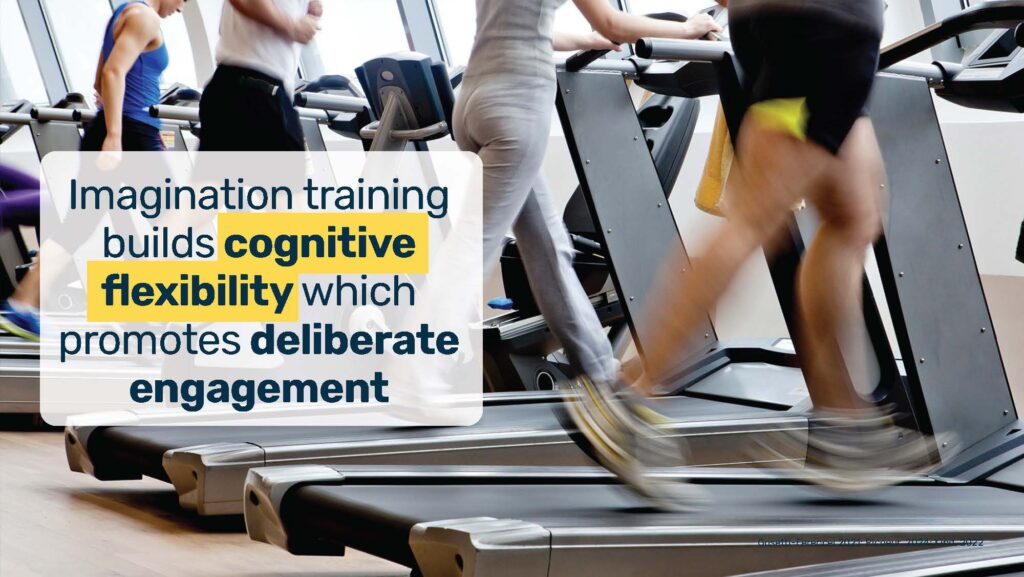
The good news is that imagination is a skill, and like any other skill, with training, it can be strengthened.

The goal of imagination training is to build cognitive flexibility and deliberate engagement of productive imagination, through sustained practice and effort.
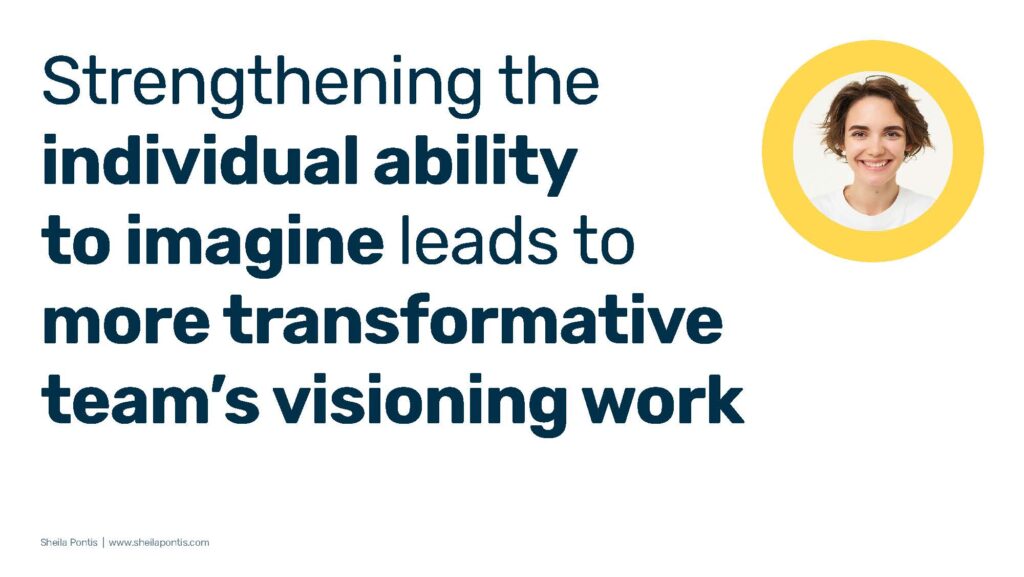
By starting with the individual and boosting our own capacity to imagine, we can improve the team’s imaginative power.
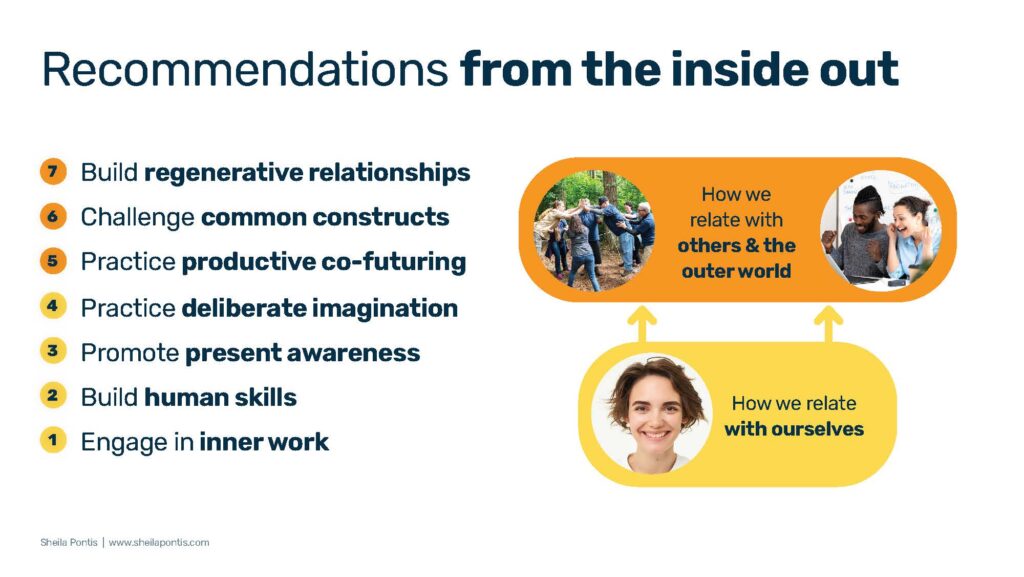
Recommendations to improve imagination in anticipatory processes can start by equip individuals to pay more attention in the present, focus inwards, and work on the relationship with themselves. Then, we can focus on nurturing how we relate with others and the outer world, as well as intentionally engage in productive co-imagination.
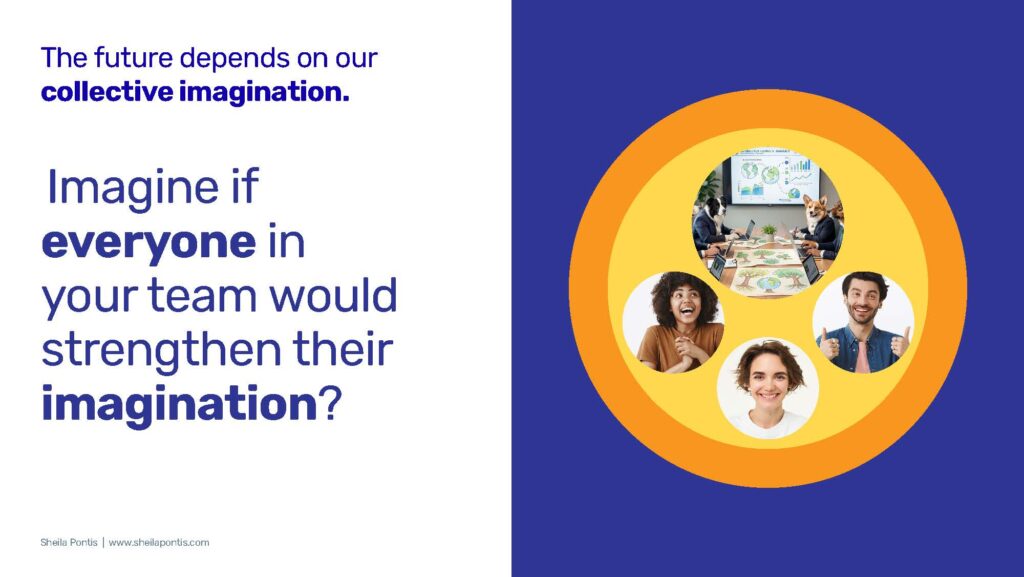
Imagine if everyone in your team would strengthen their imagination… what type of radical visions could your team be able to generate?
Thank you!
—
– Abraham, A. (2016). The imaginative mind. Human brain mapping, 37(11), 4197-4211.
– Gotlieb, R. J., Hyde, E., Immordino-Yang, M. H., & Kaufman, S. B. (2019). Imagination is the seed of creativity. The Cambridge handbook of creativity, 2, 709-731.
– Inayatullah, S. (2023). The futures triangle: origins and interactions. World Futures Review, 15(2-4), 112-121.
– Kind, A. (2022). Learning to imagine. British Journal of Aesthetics, 62(1), 33-48.
– Miller, R. (2018). Transforming the future: Anticipation in the 21st century. UNESCO Publishing.
– Mulgan, G. (2020). The Imaginary Crisis (and how we might quicken social and public imagination). UCL, Demos Helsinki and Untitled.
– Pontis (Forthcoming). Why Imagination Matters (Vol. 1, Imagination Series). Routledge.
– Ricoeur, P. (2016). Imagination in Discourse and in Action. In Rethinking Imagination (pp. 118-135). Routledge.
– Shtulman, A. (2023). Learning to imagine: the science of discovering new possibilities. Harvard University Press.
– Voros, J. (2003). A generic foresight process framework. Foresight, 5(3), 10-21.
You must be logged in to post a comment.