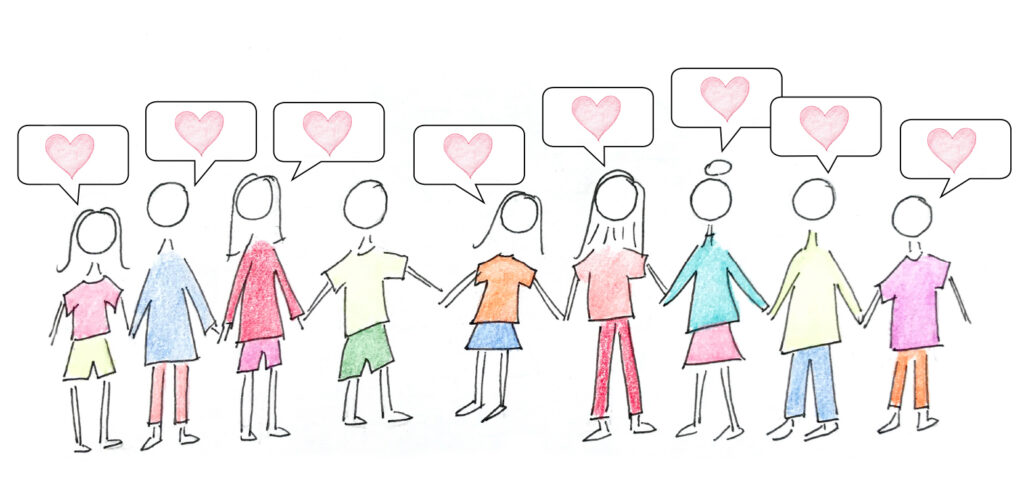
Frequently underrated and ignored, Love is another important human skill. Yes. Love. This is a neglected topic in multiple areas, from academia and education to industry and policy, and even in everyday conversations. For instance, Do you know of any courses or workshops similar that teach “love”? Do you talk with your friends about how you could get better at expressing love?
During the 2024 Inner Development Goals Summit, Jennifer Garvey Berger emphasized “love” – or genuine positive regard, as she called it – as the key ingredient for creating the right conditions for people to be successful; and I would add, for strengthening relationships of any kind and restoring hope about the future. Love, in-person relationships, and compassion are the pillars to build a strong sense of self, leading to a healthier, more caring, flourishing society. Similarly, in the Tibetan culture, love is seen as the “source of all goodness in the world” and the “basis of all beneficial actions” (Kongtrul, 2018:5,6, 16), while in Buddhism, metta or “loving-kindness” refers to an unselfish mindset concerned with helping others be happy, and turning attention away from ourselves.
Love is not a passive emotion. It is a skill; and as a skill we can practice it and get better at it. But, what is Love?
Commonly “love” is associated with romantic emotions and relationships. However, not all expressions of Love involve romance or long-term commitment; some manifest through selfless acts of compassion or care for another person – someone that we know or a stranger, for the more-than-human-world, or for a thing. VanderWeele and Lee describe love broadly, providing three types of characteristics:
- Love as the desire to be united with the beloved – romantic view
- Love to contribute to the good of the beloved – which can be anything, not necessarily a person
- Love as both – romantic and contribution
When love is seen more expansively, its role in society becomes more clear. By practicing love in different forms – such as through acts of kindness, expressions of gratitude, sincere well-wishing towards others – we can start dismantling expressions of anger, violence, and selfishness, and increase empathy and authentic cooperation. These qualities are today more needed than ever.
Love also enhances human flourishing – ours and that of others, the beloved ones. By showing more love for one another, we show that we care.
Caring for another person creates a sense of purpose, and makes them feel more connected – both conditions directly promote feelings of happiness and belonging. For examples, when we practice deep listening, we are engaged in a form of love, because we are providing selfless attention to the other person that makes them feel seen and valued.
Leading with love lowers the other person’s fear and self-defense barriers. Remember: human’s default mechanism is survival. When we lead with love, the other person’s survival mode gets override, which manifests through biological, psychological, and emotional changes, like a more relaxed body language or feeling more connected to others. It also boosts positive feelings, nurturing hope and joy. Margaret Wheatley said it clearly: if there is no joy, we cannot survive; joy is not a luxury.
Love can be nurtured in almost any setting: within families, friendships, education, workplaces, politics, supermarkets, sports. So, why is so uncommon to openly speak about this skill at work or with friends? Why don’t we practice it more often? To start boosting Love, paying conscious attention to how this skill manifests everyday is the first step. This awareness will lead us to find ways to individually and collectively promote it more often, in more places. Care, respect, responsibility for others are ways in which we can practice Love daily – and contribute to building a healthier, more caring society.
—
Kongtrul, D. (2018). Training in tenderness: Buddhist teachings on tsewa, the radical openness of heart that can change the world. Shambhala.
VanderWeele, T. J., & Lee, M. T. (2025). Love and human flourishing. International Journal of Wellbeing, 15(4), 4663, 1-31. https://doi.org/10.5502/ijw.v15i4.4663
Wheatley, M. (2002). Turning to one another: Simple conversations to restore hope to the future. Berrett-Koehler Publishers
You must be logged in to post a comment.