Habits, technology, jobs, and implicit social norms encourage and celebrate multitasking, productivity, and efficiency. Consequently, we are never fully in the present moment. We are always slightly elsewhere, doing more than one task at the time.
Multitasking is a conscious decision—motivated by being productive and more efficient—to do as many tasks simultaneously as we can, and allocating the same level of importance to each activity: We drink coffee AND write emails; we walk AND text a friend; we are in a meeting AND check emails. The assumption is that this behavior would lead to having more free time to spend with friends and family, or do a non-work-related activity.
When we aren’t multitasking (and even when we are!), our attention is divided looking for what is going on around us, fed by both the fear of missing out and the desire to constantly stay connected. This automatic behavior was described as “continuous partial attention” by Linda Stone in the late 1990s.
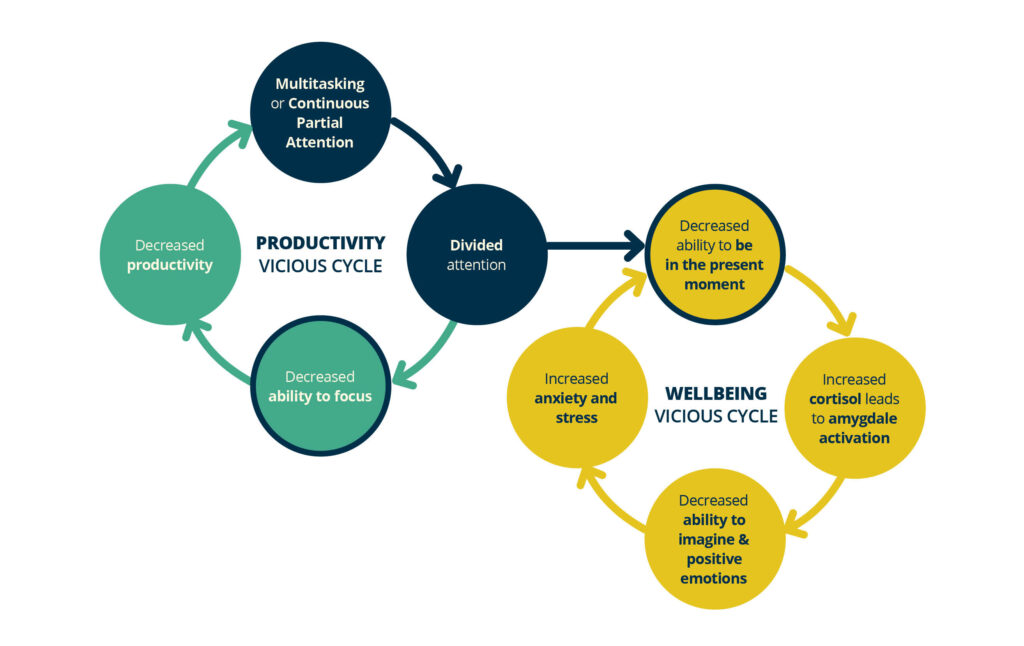
However, multitasking and continuous partial attention can lead to two vicious cycles:
- Decreased productive
- Decreased imagination and wellbeing
Our brains were not built to be doing more than one conscious task at the same time. When we are continuously paying partial attention to two activities, the result is a decrease in our ability to focus and be in the present moment. When we think we are multitasking, our minds are actually switching rapidly between tasks. This constant task-switching depletes both our cognitive energy and the quality of attention we bring to anything. As a result, we are never truly focus on anything we are doing: a design task, cooking a meal, or having a conversation with a friend—and the outcome is not as good as it could be.
When we engage in more than one task at the time —consciously or unconsciously— our minds become less productive because we use our cognitive energy faster. Humans are built to do one task at the time, while paying full attention: We (1) notice something, (2) go towards it, and (3) focus in.
In addition to low productivity, this common behavior negatively impacts emotional wellbeing and imagination.
Continuous partial attention leads to us being continuously in high alert, feeling stressed and anxious. Simultaneously, this initiates a cascade of stress hormones, like cortisol, which both keeps the fight-or-flight response activated and reduces the ability of dopamine and seratonin to attach to a receptor site (as cortisol is using available spaces). These hormones are key for emotional wellbeing: while dopamine impacts motivation, seratonin regulares emotional balance and sleep.
Then, active cortisol also activates the amygdale, which suppresses the brain Default Mode Network, decreasing our ability to imagine. This network is behind most forms of imagination. It allows the brain to daydream, time travel into the future or into the past, and rearrange memories into new mental imagery.
Like deep listening, what unlocks our full potential is the opposite of multitasking; it is full attention and deep focus on one task at the time. Being fully present is what also leads to increased imagination and emotional wellbeing. As Robert Waldinger says:
“Attention is the best medicine. Where we choose to direct our attention changes how we experience life.”
Today pay attention to what your mind does and where it goes when you are in a meeting (or doing any other task): Are you fully present? Or do you have your email (or the newspaper, or Youtube) open in another browser or tab? If you are nodding to the second question, smile, and bring your mind back to the task at hand.
You must be logged in to post a comment.