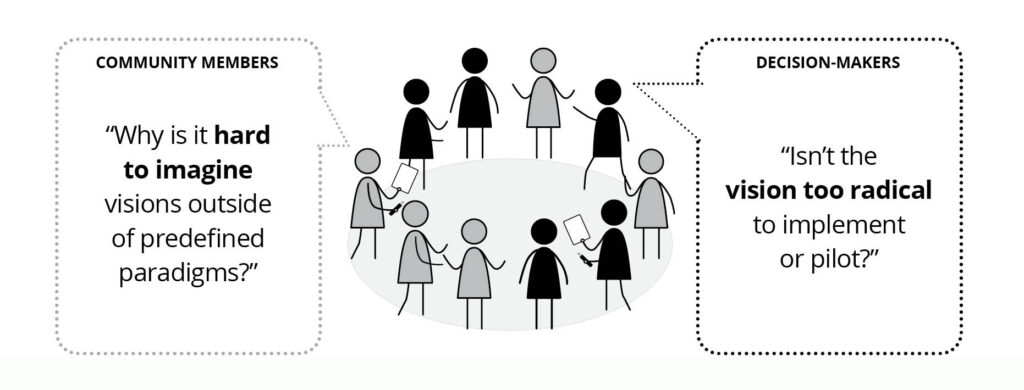
Radical societally transformative visions propose multiple social and human infrastructure shifts:
- How authority, power, and resources are structured
- How practices and processes reflect and implement those structures
- What norms, values, and beliefs form the foundation and shape structures and processes
- How these dimensions are connected to ecological systems across multiple scales
Pluralistic collaborations between stakeholders from diverse backgrounds (academia, industry, government, communities, etc.), each with their own knowledge, views, and methods working together, are needed to generate such transformative visions. Unfortunately, these collaboration and these visions are not as common as they should be. Rather, popular visions and ideas for the future reflect our lack of hope and optimism by recycling old ideas or proposing technology saturated notions of the future. Similarly, institutions and organizations perpetuate narrow, pre-existing ways of thinking and doing.
Three important factors are at play.
(1) Mindless and irresponsible engagement with technological systems and tools. When we engage with AI —or any other advanced digital tool— irresponsibly, we give away our agency and identity. Progressively, we forget how to be human —even how to imagine. Our lack of deliberate imagination practice is limiting our capacity to envision, reshape, and build more sustainable futures.
(2) Common inaccurate beliefs and narrow views about imagination. Despite its growing relevance to both society and multiple domains, imagination is still often seen as an unscientific or artistic subjective approach, rather than a valuable and needed competency for bringing about change. Our individual and collective imagination is underutilized.
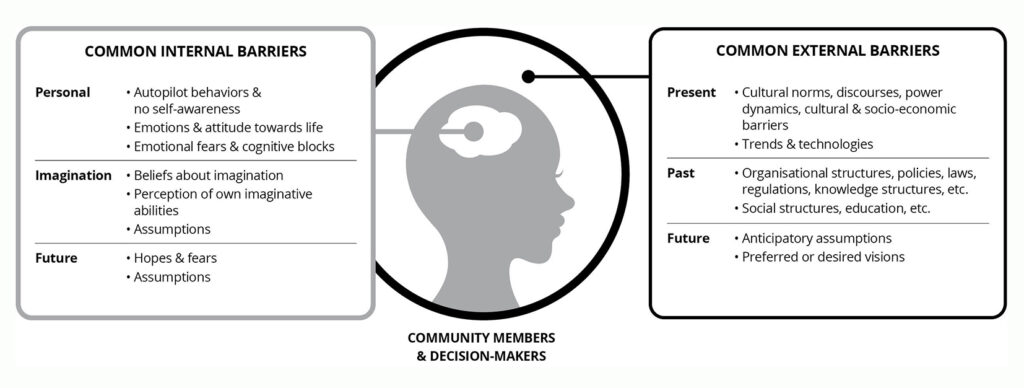
(3) Our internal and external barriers limit our potential to imagine and bias organizations’ decision-making. Internal barriers or “blind spots” represent our views, values, and beliefs based on our past and daily experiences with the social and natural worlds, as well as the built environment. They constrain the perception of our own imaginative abilities and narrow imagination to preparation, planning, and realistic uses. When our “blind spots” are unchecked in pluralistic conversations, they can negatively influence engagements throughout a project, because radical visions about the future are shaped by challenging existing paradigms rooted in past and in current social, physical, and ecological systems. While we have little control over external barriers, we can control our internal barriers.
From the Inside Out
Inner work can help us uncover the inherited patterns, biases, and blind spots that limit our worldviews and be more open to different perspectives and intentions when working with pluralism. Together the practice of human skills and deeper self-awareness can equip us with the capabilities to shift our cognitive abilities from an unconscious to a conscious state, giving us more control. Emotional intelligence, deep listening, connectedness, optimism, and imagination are examples of human skills central for systemic social transformations.
At individual level, when we connect with ourselves, others, and the world, we think more expansively about the future and amplify our capacity to generate new alternatives. As a collective, human skills and self-awareness help minimize resistance and disagreements, strengthening the development of generative collaborations and quality of the outputs. More empathic teams are able to identify temporal biases, articulate assumptions informing views of the future, reveal how uncertainty is perceived, and examine the moral and ethical implications of future visions. Similarly, this awareness can shed light on and broaden decision-makers’ ability to consider which visions to implement. In other words, inner work can narrow the imagination deficit and support the development of societally transformative visions.
—
Inayatullah, S. (2023). The futures triangle: Origins and iterations. World Futures Review, 15(2-4), 112-121.
Kania, J., Ruparell, E., Senge, P., & Hamilton, H. (2026, March 6). The inner work of system leadership. Garrison Institute. https://www.garrisoninstitute.org/get-inspired/read/the-inner-work-of-system-leadership-2/
Manuel-Navarrete, D., Grauer, C., Chilisa, B., Brundiers, K., Sanusi, Z. A., Seidel, T., Tolksdorf, F. L., & Lang, D. J. (2025). Inclusive transdisciplinarity: Embracing diverse ways of being and knowing through inner work. Ecology and Society, 30(3), 22. https://doi.org/10.5751/ES-16197-300322
Moore, M. L., & Milkoreit, M. (2020). Imagination and transformations to sustainable and just futures. Elem Sci Anth, 8(1), 081.
Múnera-Roldán, C., Grigg, N., Miller, C. A., Leith, P., & Dunlop, M. (2026). Beyond the imagination gap: limits, constraints, and opportunities for sustainability research and practice. Earth System Governance, 29, 100351.
You must be logged in to post a comment.