Author: sheilapontis
-
The Value of the Design Profession
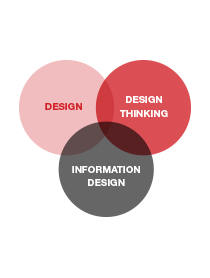
In the last five years, design thinking has gained huge popularity. Different versions of the process are being taught in non-design schools and universities, and increasingly many companies and organisations encourage employees to gain familiarity with it. More recently, initiatives to bring design thinking into high school education have emerged, at least in the US.…
-
The Power of Solid Conceptual Design
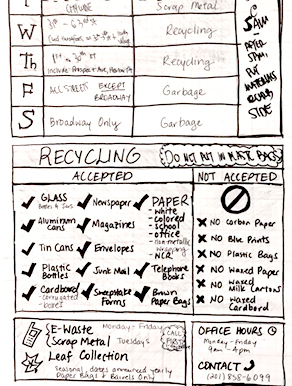
Once again, I challenged my information design students with the task of improving this garbage and recycling schedule: Working in pairs, students had around an hour to work on this challenge, but couldn’t use colour or digital tools. They followed these steps: Understand content: This was the first time students saw the schedule, so they…
-
User Studies Matter!

Skype. To me, this has been one of the most helpful tools ever created. It has allowed me to connect with friends and family (and clients, and students, and others) who aren’t in the same location as I am. Since early days, I have used it, first, to communicate between Skype user to Skype user.…
-
The fear of giving feedback
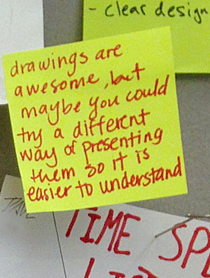
As I approach the end of the semester and an intense year of teaching, I like to reflect on the highlights and learnings from each course. Interestingly, this year I noticed a common phenomenon across most of the courses I taught: students’ reluctancy to give (meaningful, constructive and critical) feedback or share what they really…
-
Thinking Creatively with UN Leaders
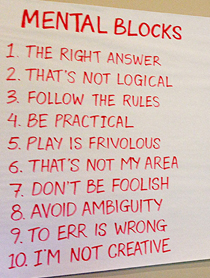
This month Innovations for Successful Societies (ISS) research programme worked together with the United Nations System Staff College (UNSSC) to organise a 3-day leadership workshop for 16 senior United Nations staff focused on developing more innovative ways to help achieve the sustainable development goals. As part of this event, I co-facilitated the sessions about creativity…
-
Is simple the new complex?
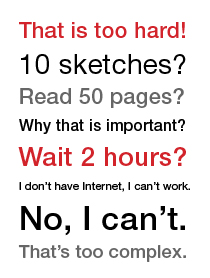
The way people communicate and process information has changed. These changes are most notably in younger generations, daily interactions (digital or face-to-face) and various ways of expressing ideas (e.g. articles, social media). Recently, I have started to see a connection between these phenomena and our receptiveness to deal with problems; even when these could be…
-
A Tool From a Novice’s Perspective

This summer I have been exploring the world of quantitative analysis, statistics and data visualisation (here by data vis I’m specifically referring to visualisations purely created with large quantities of numeric data). As part of this journey, one of my aims was to gain familiarity with Tableau, as it is one of the most frequently…
-
Field Research in Information Design

If you are an information designer you can enhance your work by using field research. However, this type of research is still frequently overlooked in information design professional practice (the research community does conduct research studies, but that reality is very different from what occurs in the daily design practice). Traditional market research methods (surveys, online…
-
Five things I learnt from my students

For the last two years, I have been teaching various flavours of design (information design, design thinking, interaction design) in non-design institutions. So far, the experience has been extremely eye opening but also challenging as when I started, I didn’t know how different it would be from previous years of teaching similar courses in design…
-
An Ethnographic Information Design Approach II
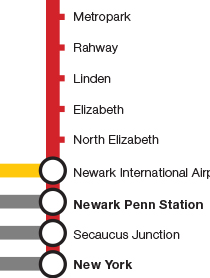
Since I have taken new challenges, my commute has changed quite a bit. However, my research+info design mind hasn’t. I can’t help paying attention to emerging patterns during my morning and afternoon commutes (among other daily situations). Last week, I was re-reading some of my old blog posts, and remembered the one I wrote illustrating the…
-
How to mirror brain cognitive processes with Information Design
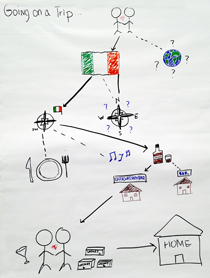
Information design solutions can look really attractive, but quite a few fail to achieve their intended goal: audience cannot understand them. Why is that? Frequently this occurs when design decisions do not support cognitive activities. Often, this is the consequence of designers using visual variables inconsistently or with no intention, but designing information with no structure or visual organisation can also be…
-
Being Designers is more than just Design

Nowadays teaching design in non-design schools and to non-design students doesn’t seem as foreign as it may have been 10 or 15 years ago. However, this experience has given me a new understanding of what “being a designer” really means. Some people describe designers as artists or creative minds, and think that anyone could become a designer just…
You must be logged in to post a comment.