Author: sheilapontis
-
Terminologies can be confusing
Sometimes, terminologies can obscure rather than shed light. Cross-disciplinary projects are the perfect scenario to illustrate this point as to achieve common understanding among all parties involved could be a challenge. Ambiguous understanding is likely to happen when we see a problem situation solely through our own eyes and fail to realise that although other…
-
the functional art: The Book
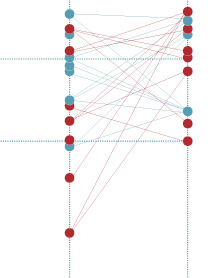
When I first heard of the functional art (Cairo, 2012), I asked myself: What makes this book different from the many other information graphics books which are currently out there? At the beginning, the word ‘functional’ caught my attention as it was in line with my practice approach and research interests. Then, during the Malofiej…
-
When people interact with information
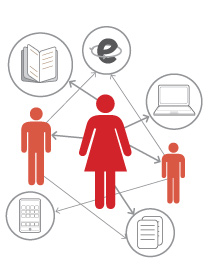
Software, intelligent devices and machines are constantly being developed to assist people’s everyday actions and help them solve problems, from simple tasks like writing, reading, shopping online or booking flights to more complex ones, such as online banking (best invention ever) and medical related analyses. While these innovations help us save time and quite a…
-
Understanding the role of Big Data
One of the current concerns among many domains (e.g. information design, technology, cognition, psychology) is how to make sense of extensive and complex sets of data in order to improve understanding and communication. While tools, systems and methods are designed to assist those purposes, the Big Data phenomenon seems to be the one to beat.…
-
Mind the gap!

Tomorrow the London Underground is 150 years old! On 8 January 1863, the journey completed between Paddington and Farringdon stations by the Metropolitan Railway (today Metropolitan line) was the very first one of the London Underground. Since then, the Underground system has grown from 30 to over 270 stations, and the number of travellers has…
-
Making sense of information (visual) practices
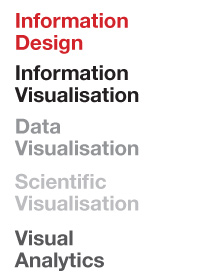
Among information (visual) fields there seems to be great confusion on the appropriate use of core terms. Particularly, the terms: information design, information visualisation and data visualisation are the ones that are daily used and, at the same time, arise more uncertainties among practitioners, academics, students and teachers from diverse disciplines. Other terms, which are…
-
Hybrid designers

When I was giving my first steps into my research bubble someone pretty close to me told me that by the end of that journey I would be a different person. Now, quite a few years later, I can confirm that he was certainly right. Throughout that journey I read countless books and papers, met…
-
Does chocolate make you (more) creative?
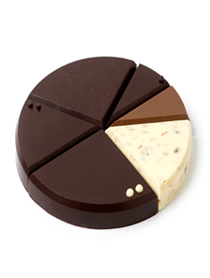
Chocolate is one of the most popular food types. Originally cacao was referred to as the ‘food of the Gods’. Nowadays, chocolate is often used as a way for saying thanks, goodbyes, apologies… It is also a loyal allied during long working hours, cold winter days, meetings and a great companion of coffee. But, most…
-
Information design rationale as a teaching strategy

For me teaching is a challenging, dynamic but highly rewarding activity. Here in Europe, students come from and have different cultural and educational backgrounds, thus, have quite uneven levels of experience, are from varied age ranges, and speak many languages. Then, students’ pencil-cases and notebooks have been almost replaced by iPads, laptops and iPhones, facilitating…
-
Applied information design: The encyclopaedia
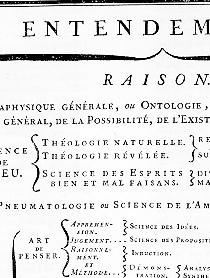
My admiration for complex information design objects started long time ago, when I found the Quillet encyclopaedia (Argentinean editorial Arístides Quillet) that my mom has at home. This collection of 4 volumes was first published in Argentina around 1940s. Each volume covers a specific list of contents and almost everything can be found there. Visual…
-
Transition times of information design
Information design is not an emerging field or subject area. This point has been highly discussed in an assortment of online and print articles, conferences and discussion groups. On-going debates defining its boundaries, its commonalities and differences with data visualisation, information architecture, and user-experience design pop up daily. Countless books have been published tackling the…
-
Applied information design: Royal Observatory
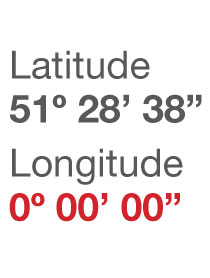
This summer, for the first time I went to visit the Royal Observatory in Greenwich. One of the main attractions there is the Meridian Line, which divides the world into two imaginary halves: East and West. I found the whole journey, from Cutty Sark DLR station to the top of the hill pretty interesting and full…
You must be logged in to post a comment.